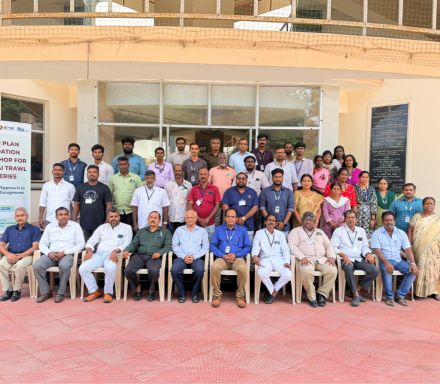
EAFM Plan Validation Workshop under the Chennai Trawl Fisheries Project at Madras Regional Station, ICAR-CMFRI
The EAFM Plan Validation Workshop under the BOBP-ICAR-CMFRI project on ‘Preparation of Scoping Report & Plan towards Implementation of the Ecosystem Approach to Fisheries Management (EAFM) in Chennai Trawl Fisheries’ was organized at Madras Regional Station of ICAR-CMFRI on 16th July, 2026. The objective of the workshop was to finalize the EAFM Plan for Chennai trawl fisheries covering the three broad domains of ‘Ecosystem Approach’ viz., ecological well-being, human well-being and effective governance.
In his inaugural address, Dr. E. Vivekanandan, Consultant, Bay of Bengal Programme- Inter-Governmental Organisation (BOBP-IGO) presented an overview of EAFM. The BOBP-IGO is supporting the application of EAFM in selected fisheries management units in South Asia. These activities are intended to complement national institutional mandates by facilitating fishery-level planning processes, capacity development, and documentation, while fully respecting national roles and responsibilities. In this process, BOBP-IGO has been collaborating with ICAR - Central Marine Fisheries Research Institute (ICAR-CMFRI) to support the application of EAFM in India. Under this context, the BOBP-IGO offered this contract to Madras Regional Station of ICAR-CMFRI to undertake the project ‘Preparation of Scoping Report & Plan towards Implementation of the EAFM in Chennai Trawl Fisheries’. The purpose of this assignment is to support the application of the Ecosystem Approach to Fisheries Management (EAFM) by undertaking structured scoping studies and preparing fishery-specific EAFM Plans that can inform science-based, participatory, and sustainable fisheries management.
Dr. J. Charles Jeeva, PI of the project made a brief presentation on the EAFM Plan for Chennai Trawl Fisheries. Dr. A.K. Abdul Nazar, Scientist-in-Charge of the Centre presided over the programme. Dr. S. Ram Kumar, Sr. Scientist, Smt. P. Gomathi, Scientist and Dr. S. Gomathy, ACTO moderated the breakout group discussions on the themes, ‘ecological well-being’, ‘socio-economic well-being’ and ‘good governance’. The participants were divided into the following four thematic groups and offered their inputs for finalizing the EAFM plan covering the following six goals and thirteen objectives.
Group | Goals and Objectives |
Group 1: Sustainable Trawl Fishing Practices and Traceability | Goal 1: Sustainable Trawl Fishing Practices Promoted Objective 1.1 : Develop trawl fishery database Objective 1.2 : Promote responsible fishing practices Objective 1.3 : Develop Chennai Trawl Fisheries Management Plan
Goal 4 : Traceability for the Value Chain of Selected Species Established Objective 4.1 : Develop and pilot traceability framework for the value chain of selected species
|
Group 2: Upgrading Chennai Fishing Harbour | Goal 2: Chennai Fishing Harbour (CFH) upgraded into a Modern Fishing Harbour Objective 2.1 : Improve infrastructure and technology Objective 2.2 : Promote pollution-free Chennai Fishing Harbour (CFH)
|
Group 3: Improving Economic Benefits, Social Security and Sea Safety
| Goal 3: Economic Benefits Enhanced Objective 3.1 : Strengthen retail fish marketing infrastructure in Chennai Fishing Harbour (CFH) Objective 3.2: Establish Digital Fish Marketing System
Goal 5: Financial, Social Security and Sea Safety Improved Objective 5.1 : Improve access to institutional finance, social support systems and sea safety measures
|
Group 4: Governance and Institutional Coordination
| Goal 6 : Governance and Institutional Coordination and Cooperation Strengthened Objective 6.1: Increase institutional coordination and cooperation Objective 6.2: Strengthen implementation and monitoring of Tamil Nadu Marine Fishing Regulation Act Objective 6.3: Establish Coordination Committee for increased participation of fishers and relevant stakeholders Objective 6.4 : Enhance community awareness on ecosystem conservation, sustainable fishing and recent developments |
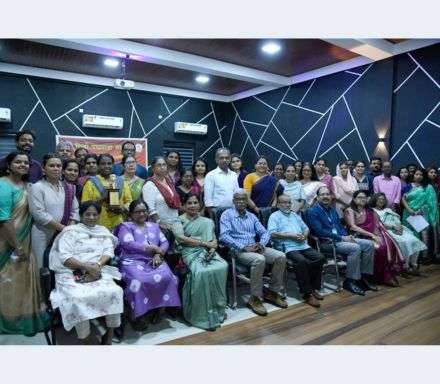
About 50 stakeholders representing trawl boat operators associations, trawl boat owners, artisanal fishers, officials from the Department of Fisheries, Govt. of Tamil Nadu, boat workers, NGOs, fish traders and women fish vendors participated and deliberated on the EAFM Plan.